

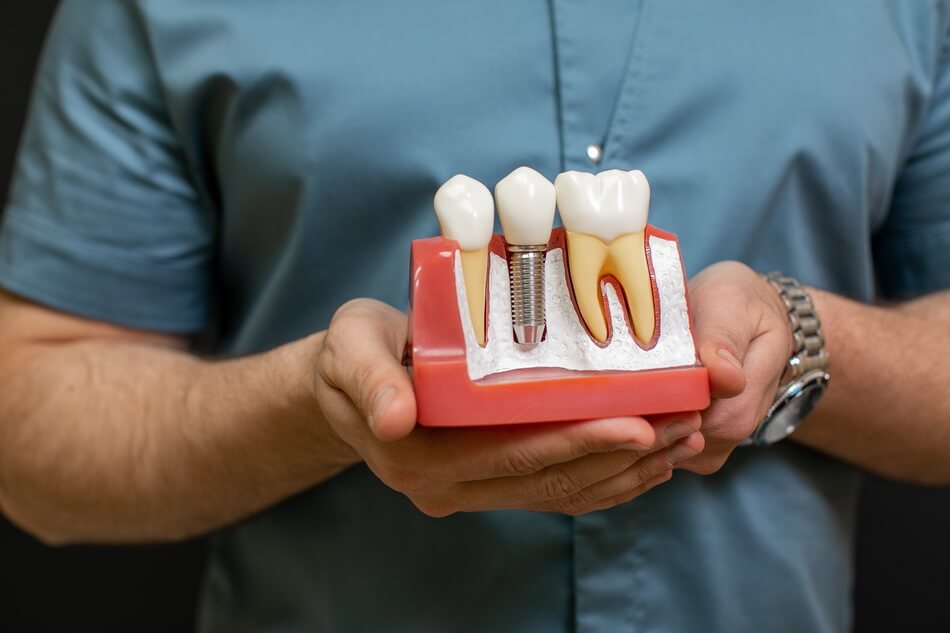
Oral and dental health is considered an essential part of overall well-being, as tooth loss greatly affects one’s ability to chew and speak, in addition to its negative impact on facial aesthetics and self-confidence. With the advancement of modern dental technology, dental implants have become one of the best available solutions for replacing missing teeth, offering a permanent and natural-looking restoration that mimics real teeth in both appearance and function.
This makes them an ideal choice for individuals looking to restore their smile and enhance their overall oral health. Dental implants not only improve aesthetics but also play an important role in maintaining the health of the jawbone. When teeth are lost, the jawbone begins to resorb due to the absence of tooth roots that stimulate bone growth.
Dental implants help prevent this bone loss by providing strong support to the bone, maintaining facial structure, and reducing wrinkles caused by bone resorption. Additionally, implants offer more comfort compared to traditional solutions such as dentures or dental bridges.
For instance, removable dentures can cause discomfort while eating or speaking and may require frequent adjustments as the jawbone shape changes over time. In contrast, dental implants are fixed and stable, providing a natural feel while improving chewing and speech abilities. Psychologically, dental implants help restore confidence, allowing patients to smile and communicate comfortably without feeling embarrassed about their teeth’s appearance.
This positive effect on mental health can reflect on other areas of life, such as social relationships and professional performance. Moreover, dental implants have a long lifespan when properly cared for. With good oral hygiene and regular dental visits, implants can last for decades without the need for replacement—making them a long-term investment compared to other solutions that may require periodic maintenance or replacement after several years.
What Are Dental Implants?
Dental implants involve placing an artificial root made of titanium into the jawbone to act as the foundation for a crown that resembles natural teeth. The procedure is performed under local anesthesia, where the artificial root is inserted into the bone, allowing it to fuse with the natural bone over several months before attaching the artificial crown.
Dental implants are a long-term solution compared to traditional options like dentures and bridges, as they provide greater stability and help avoid many oral health problems.
Types of Dental Implants and the Differences Between Them
1- Titanium Implants:
Properties:
Made from titanium, the most commonly used material in dental implants due to its excellent biocompatibility and ability to integrate quickly with the jawbone.
Advantages:
- Strong and durable, ensuring long-term use.
- Extremely high success rate, reaching up to 95%.
- Suitable for most patients, including those with partial bone density loss.
Disadvantages:
Some patients may have metal sensitivity, making zirconia implants a better choice for them.
2- Zirconia Implants:
Properties:
Made from white zirconia, which closely resembles the natural tooth color—making it an excellent cosmetic option.
Advantages:
- Metal-free, ideal for patients with metal allergies.
- Offers a more natural appearance, especially in the front teeth area.
- Reduces the risk of gum inflammation compared to titanium implants.
Disadvantages:
May be less durable than titanium in some cases and requires greater expertise during placement to ensure implant success.
The Difference Between Dental Implants and Other Traditional Solutions
Comparison Between Dental Implants and Removable Dentures:
- Stability and support: Implants provide far more stability compared to removable dentures, which can shift while eating or speaking.
- Comfort: Implants are more comfortable for those with gum sensitivity, as they do not cause the irritation often associated with dentures.
- Longevity: Dental implants last much longer, while removable dentures may need replacement after several years due to bone wear or jaw changes.
- Chewing function: Implants restore natural chewing ability, whereas removable dentures can affect chewing efficiency and digestion.
- Bone preservation: Implants prevent jawbone loss over time, while long-term denture use can lead to bone resorption.
Comparison Between Dental Implants and Fixed Bridges:
- No need for tooth reduction: Traditional bridges require preparing adjacent teeth for support, while implants preserve healthy natural teeth.
- Lifespan: Implants last longer than bridges, which may require replacement after several years due to adhesive failure or decay if oral hygiene is poor.
- Bone support: Implants maintain jawbone density, while fixed bridges do not provide the same benefit and may contribute to bone loss over time.
- Natural appearance: Dental implants mimic natural teeth more closely and integrate better with the gums.
Main Components of Dental Implants
Implant root: Made of titanium or zirconia, it fuses with the jawbone over several months to provide a strong, stable base for the new tooth.
Artificial crown: The visible part that looks and functions like a natural tooth, made of high-quality materials such as ceramic or zirconia to withstand chewing pressure.
Abutment: The connector piece that links the implant root to the crown, usually made from titanium or ceramic for lasting stability and biocompatibility.
Implant Longevity
Dental implants have a high success rate, often lasting decades when properly maintained through regular oral hygiene and dental check-ups. It’s essential to follow a healthy diet and avoid harmful habits such as smoking or chewing hard objects, as these can shorten implant lifespan.
Regular visits to your dentist at Wonders Dentistry for professional cleaning and examinations will help ensure long-term success and health of your implants.
Dental Implant Costs vs. Value
Although the initial cost of dental implants may seem high, they are a long-term investment that offers significant value compared to other traditional solutions such as removable dentures or fixed bridges.
The cost of implants varies depending on several factors, including the number of teeth to be replaced, the materials used (titanium or zirconia), and the experience of the implant specialist.
However, the numerous benefits of implants make them a cost-effective solution in the long run.
Factors Affecting Dental Implant Cost
- Number of implants: The more teeth being replaced, the higher the total cost.
- Implant type: Titanium implants are generally less expensive than zirconia, which is more advanced cosmetically.
- Jawbone condition: Patients with low bone density may need bone grafting procedures, increasing the cost.
- Dentist’s expertise and location: Costs vary depending on the dentist’s experience, clinic reputation, and geographic location (major cities typically have higher prices).
- Technology used: Advanced technologies such as 3D imaging or computer-guided surgery may increase costs but ensure more accurate results.
Tips for Caring for Dental Implants
- Brush regularly: Use a soft-bristled toothbrush and suitable toothpaste to clean around the implants daily.
- Use dental floss: Helps remove food debris and plaque between teeth and around implants.
- Regular dental visits: Essential for early problem detection and professional cleanings.
- Avoid harmful habits: Such as smoking or biting hard objects, which can damage implants.
Psychological and Social Benefits of Dental Implants
- Restored confidence: Improves smile aesthetics and self-image.
- Enhanced speech: Helps eliminate speech difficulties caused by missing teeth.
- Improved social interactions: Provides comfort while speaking and smiling in public.
Future Developments in Dental Implantology
With continuous technological advancement, new materials and techniques are being developed to improve implant outcomes—such as using 3D printing for highly precise implant manufacturing, reducing procedure time, and increasing success rates.
Dental implants are an advanced and effective solution for replacing missing teeth, offering both health and aesthetic benefits that surpass traditional methods. With proper care and maintenance, implants can last for many years, making them a valuable investment for your oral health and quality of life.
FAQs
What are the advantages of dental implants compared to fixed bridges and do they preserve adjacent teeth?
The foremost advantage of dental implants is adjacent tooth preservation. Fixed bridges require full crown preparation of neighboring teeth adjacent to the gap — even if healthy — to serve as bridge abutments, weakening their structure and making them susceptible to decay and pulp inflammation later. Implants are placed directly into the alveolar bone without affecting adjacent teeth, preserving their enamel and structure. Implants also prevent alveolar bone resorption that occurs beneath bridges due to absent mechanical stimulation, while implants mimic natural tooth roots and stimulate bone regeneration through osseointegration. Functionally, implants restore 100% of masticatory force compared to bridges which reduce it by 30–40% due to pressure distribution on supporting teeth.
How do dental implants prevent jawbone atrophy and facial changes with aging?
Jawbone preservation is one of the most important advantages of dental implants long-term. When a tooth is lost, the alveolar bone loses the mechanical stimulation it received from root pressure during chewing, leading to bone resorption at 0.5 to 1 mm annually in the first year, continuing at a slower rate. This atrophy changes facial shape causing sunken cheek appearance and wrinkle formation around the mouth. Implants made of titanium or zirconia transfer chewing forces directly to bone via the peri-implant ligament, stimulating osteoblast cells to form new bone and preventing resorption. Long-term studies show implant patients maintain 95% bone density after 10 years, compared to 50–60% bone loss in removable denture users.
Are dental implants suitable for smokers and how does smoking affect their advantages?
No, smoking significantly weakens the advantages of dental implants and is a major risk factor for implant failure. Nicotine and tar cause: vasoconstriction in gingival and bone microvasculature, reducing oxygen and nutrient delivery by 40%. Impaired immune cell response, increasing infection risk around the implant. Slowed osseointegration, extending healing from 3–6 months to 6–9 months. Increased peri-implantitis risk by 200% compared to non-smokers. Nevertheless, smokers can undergo implantation provided they quit completely for at least two weeks before surgery and two months after. Some specialized clinics use PRP (Platelet-Rich Plasma) and PRF (Platelet-Rich Fibrin) to partially compensate for damage, but results remain less ideal than non-smokers.
What are the advantages of immediate dental implants and can you get a tooth on the same day?
Immediate implant placement is one of the latest advantages of dental implants, giving patients a temporary tooth on the same day. The damaged tooth is extracted and the implant placed in the same session, followed by immediate provisional crown placement. Advantages include: reducing surgeries and visits from 3–4 to a single session. Preserving the buccal bone plate that may resorb if implantation is delayed. Immediate smile and function restoration without months of waiting. However, this technique is limited to cases meeting strict criteria: absence of infection at extraction site, sufficient alveolar bone (at least 5 mm), and high primary implant stability (Insertion Torque ≥ 35 N/cm). In cases not meeting these criteria — such as severe infection or bone atrophy — delayed placement after 3 months of healing is preferred.
Do the advantages of dental implants justify the high cost compared to removable dentures long-term?
Yes, the advantages of dental implants make them economically sound long-term despite higher initial cost. Removable dentures require relining every 2–3 years at $200–500 cost, and full replacement every 5–7 years at $1,000–3,000 cost. They also cause residual ridge resorption requiring subsequent bone grafting surgeries. Implants last 20–30 years or a lifetime with proper care, requiring only annual maintenance at $100–200 cost. Functionally, implants restore 100% chewing efficiency compared to 25–30% for removable dentures. Psychologically, studies show implant patients enjoy higher oral health-related quality of life (OHRQoL) by 85% compared to denture patients. When calculating total cost over 20 years, implants are less expensive than dentures with incomparable health and aesthetic benefits.


