

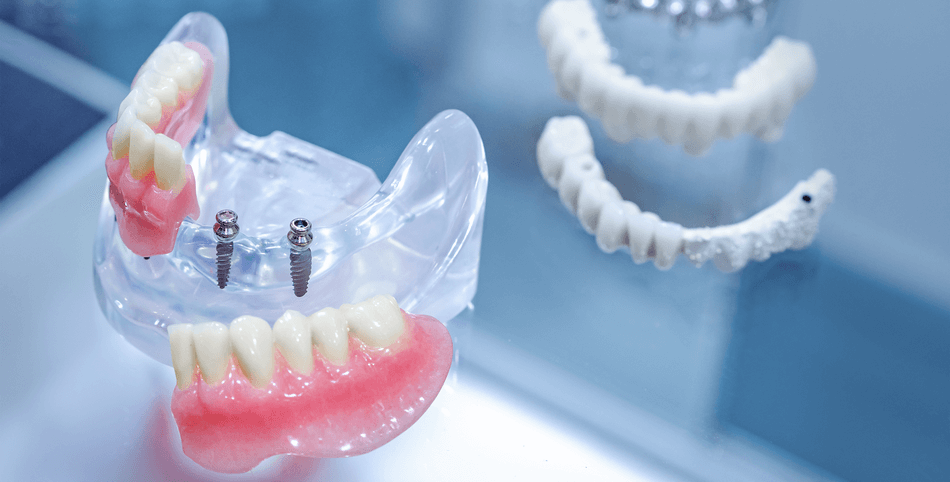
Many people suffer from low confidence or discomfort when wearing a traditional full denture due to its slipping during speaking, eating, or even at rest, which pushes them to look for a more stable solution that mimics natural teeth function. Here, the denture on dental implants technique appears as a revolutionary option that combines aesthetic appearance with durable performance.
There are many solutions for tooth loss problems. Today, we discuss another solution for complete tooth loss, which is the denture on implants, also known as an overdenture. This article will include the features of this type of prosthesis, how it is similar to and different from the traditional full denture, its fabrication stages, and how to care for it.
What is a denture on dental implants?
There are two main types of dental prostheses, which are divided into fixed prostheses and removable prostheses. Fixed prostheses cannot be removed after placement, such as dental bridges, dental crowns, and dental implants. Removable prostheses, on the other hand, can be taken out, such as dentures.
Each of these types has advantages and disadvantages, like any replacement for missing teeth. From here, modern techniques were developed to combine the advantages of both fixed and removable prostheses, such as the denture on implants.
This implant-supported denture is a removable prosthesis that replaces the gums, jawbone, and all missing teeth. It is considered a full denture, in addition to being supported by implants, which gives it more stability than traditional removable dentures.
The steps of this type of denture are somewhat similar to the initial stages of traditional dentures, but with the addition of dental implant placement. This denture is characterized by requiring a small number of implants—for example, the upper jaw typically needs 4 to 6 implants, while the lower jaw requires 2 to 4 implants.
When is a denture on implants used?
An important question arises: in which cases is this implant-supported denture used? The answer is as follows:
- Cases of complete tooth loss for long periods accompanied by jawbone resorption, making traditional solutions like removable dentures or implants alone often unsuitable.
- In cases of instability of traditional dentures. Some patients may not have major issues but need improved stability. Existing removable dentures in good condition can be converted into implant-supported dentures with some modifications and proper implant planning.
Types of full dentures on implants
Denture supported by 4 implants:
All-on-4 restorations are the most common type because they are relatively cost-effective and suitable for most jaws. They are supported by four implants and provide sufficient stability for most users.
Denture supported by 6 implants:
All-on-6 provides greater stability and distributes chewing forces more evenly across the bone. It is preferred for upper jaws or patients with lower bone density.
Denture supported by 8 implants:
All-on-8 is considered closest to natural teeth in appearance and offers excellent load-bearing capacity. It is often used as a long-term solution for patients seeking maximum performance and comfort.
How is a denture fixed on dental implants?
This denture is fixed during the final delivery appointment. The dentist uses specific tools and techniques to create small recesses in the denture. Then, a pink denture material known as acrylic resin is used to attach the implant components to the denture under pressure. This process is called the pick-up technique.
The components placed over the implants come in different shapes, types, and sizes, selected based on factors such as the distance between the upper and lower jaws and the number of implants. These include systems like ball and socket, magnet attachments, and Locator attachments, among others.
Steps for placing a denture on dental implants
Comprehensive diagnosis using 3D imaging to evaluate bone density and plan implant placement accurately.
Digital planning based on oral scanning to ensure ideal implant positioning.
Determining the number and type of implants according to jawbone condition and denture size.
Local anesthesia to ensure patient comfort during the procedure.
Implant placement in pre-planned positions, with immediate placement of a temporary prosthesis.
Placement of a temporary denture during the healing phase (usually 3–6 months).
Regular follow-ups to monitor bone healing and tissue response.
Placement of the final denture after confirming implant stability.
Post-treatment instructions, including oral hygiene and avoiding certain hard foods.
Advantages of implant-supported dentures
This type of denture offers several benefits that make it stand out among removable prostheses:
- Thanks to dental implants anchored in the jaw, full stability can be achieved—even when eating hard foods, it will not move like traditional dentures.
- Chewing efficiency reaches approximately 80% of natural teeth, restoring a natural eating experience.
- Helps preserve jawbone from resorption due to natural pressure, reducing gum recession and maintaining facial structure.
- Reduced pressure on the jawbone, helping maintain bone and gum health while providing a natural appearance and better facial expressions.
- Excellent stability, especially in cases of bone resorption or long-term tooth loss, using advanced attachment systems like metal bars or precision clips.
- Made from lightweight materials such as high-quality acrylic or zirconia, making them comfortable and long-lasting.
- Utilizes less invasive implant techniques in many cases, supported by digital planning and guided systems to reduce healing time and swelling.
- Does not require complex implant procedures or long planning periods—only a relatively simple and short procedure with fewer implants.
- The limited number of implants makes the cost relatively close to traditional dentures.
Disadvantages of dentures on implants
Like any dental prosthesis, this option has some drawbacks that should be considered:
- Requires a dental implant procedure initially, which some patients may prefer to avoid, even though it is relatively simple.
- Requires more care than traditional dentures, as plaque and fungal buildup around implants can lead to bone loss and implant instability.
- Over time, attachment components may wear out, leading to reduced stability.
Care for implant-supported dentures
Daily tips:
It is recommended to clean the denture and gums around the implants twice daily using a soft toothbrush. Special dental floss or interdental aids should be used to clean underneath the denture. A balanced diet rich in calcium and vitamin D supports surrounding bone health.
Periodic maintenance:
Regular dental visits every 6 months are essential for thorough examination of the denture, implants, and jaw. The denture may be removed for inspection of attachments, and occlusion adjustments may be made if needed. Radiographic evaluations are also performed to ensure there are no signs of bone loss or inflammation.
Final thoughts
If you are struggling with a traditional full denture or seeking a smile that closely resembles natural teeth while restoring confidence in eating and speaking comfortably, then a denture on dental implants may be the ideal solution. This technique offers high stability, an attractive appearance, and strong chewing function that lasts for years.
Do not hesitate to consult a specialist at Wonders dentistry to evaluate your condition and determine the best treatment option. Your journey toward a confident, natural smile may be closer than you think.
FAQs
What is the main difference between a traditional denture and an implant-supported overdenture?
A traditional denture relies on suction with the gums, making it prone to movement. An implant-supported overdenture snaps securely onto implants, providing superior stability without the need for adhesives.
Can I convert my existing denture into an implant-supported one?
In many cases, yes. If your current denture is in good condition, it can be modified at Wonders dentistry by adding special attachments compatible with implants.
How many implants are needed to secure a denture?
For the lower jaw, two implants may be sufficient. For the upper jaw, four implants are usually recommended due to differences in bone density.
Is cleaning an implant-supported denture complicated?
Not at all. Since it is removable, you can easily clean both the denture and the implant attachments, making it a practical option for maintaining oral hygiene and preventing inflammation.


